


Lion's mane (Hericium erinaceus) is a functional mushroom and adaptogen with a centuries-old history in Chinese traditional medicine. If you're interested in what is Lion's mane good for, you'll be glad to know it's commonly used in modern wellness routines, as the herbal ingredient supports holistic health and daily balance.1
Sometimes called yamabushitake, "pom-pom mushroom" or "bearded-tooth fungus," Lion's mane supplements come in various forms—from capsules and gummies to powders and drinks. Each form may have a different dosage. This can make things confusing when locking in your supplement stack and figuring out how Lion's mane fits into a consistent wellness ritual.
So, how much Lion's mane per day should you take? We'll answer this question below, going over the typical daily amounts used in supplements, whether the type you take matters, and when to take Lion's mane.
Key takeaways
- Lion's mane is commonly used in daily wellness routines in the form of supplements and beverages.
- There's no standardized dosing recommendation, and typical serving ranges vary depending on product type and concentration.
- Consistency and product format often matter more than a single "perfect" amount.
What is Lion's mane and why do people take it?
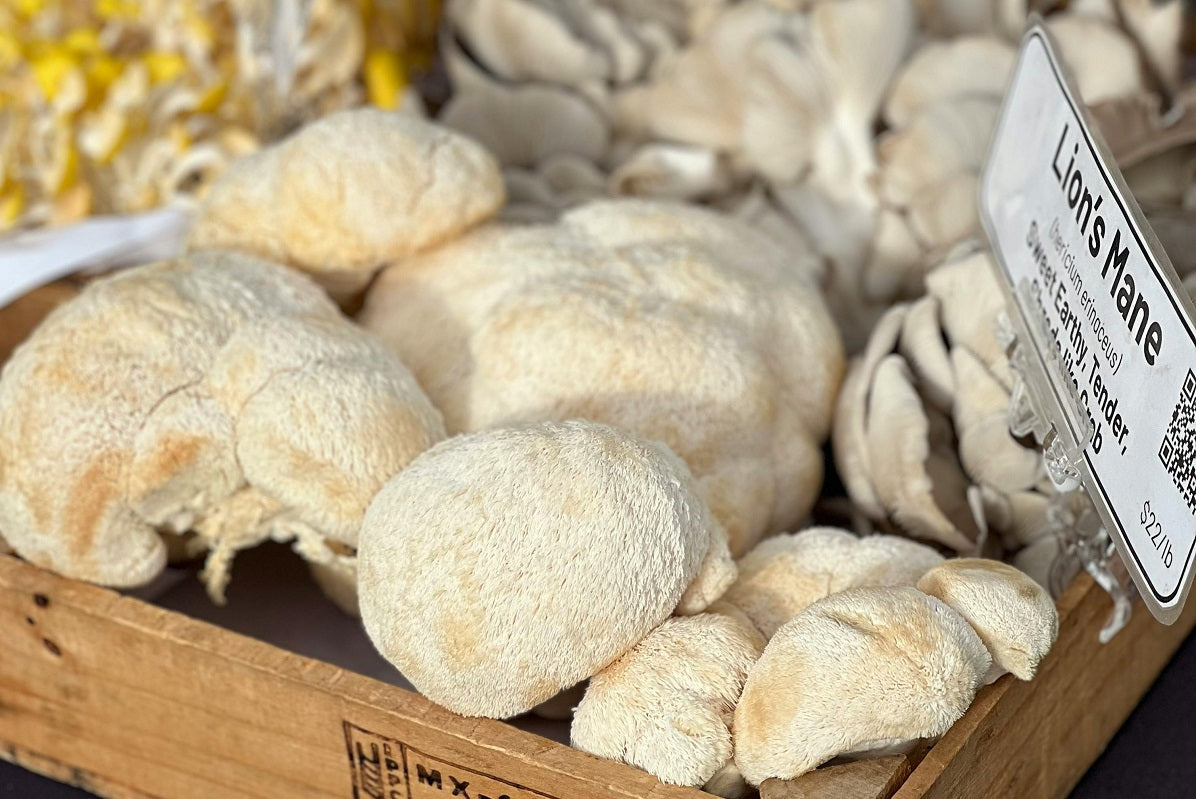
Lion's mane is a functional mushroom used in traditional wellness practices. The edible fungus grows on oak, maple and beech trees throughout North America, Asia and Europe. It's white and bulbous with a stringy exterior that resembles a Lion's mane or pom-poms (that's where it gets two of its nicknames).2
Though it's been around for centuries, it's now more widely used. You can cook with Lion's mane—the mushroom has a mild umami flavor that goes well in many savory recipes. But supplements can be more convenient for daily use, and they're available in multiple forms, including mushroom powder blends.
Lion's mane benefits
Lots of people use Lion's mane in their wellness routines. It can be part of a holistic health plan and is easy to add to your supplement stack.
The bioactive compounds in this functional mushroom have been studied for their possible effect on cognitive pathways.3,4 Some research shows that Lion's mane has adaptogenic, antioxidant and neuroprotective properties. It's associated with cognitive support and brain health while helping to stimulate focus, mental clarity and daily balance.5*
How much Lion's mane per day is typically used?
There's currently no universally established dosage for Lion's mane. But there are common ranges that vary based on supplement form and concentration. Generally speaking, people typically take anywhere from 500 to 3,000 milligrams (mg)—or 0.5 to 3 grams (g)—per day.
The daily amounts of Lion's mane used in studies on the herbal ingredient range from about 1,800 to 3,000 milligrams (1.8 to 3 grams).6,7
Some formats might be more concentrated, too. For instance, fruiting body extract (from the cap and stem) is considered more concentrated than extract derived from the mycelium (the underground root part of a mushroom).8
How much you take may have an effect on the benefits Lion's mane offers. But again, taking it consistently is most important.
Weight-based ranges in studies
Some Lion's mane studies use weight-based dosing ranging from 100 to 500 milligrams per kilogram of body weight (mg/kg).9 For instance, a person who weighs 68 kilograms (150 pounds) at a 100 mg/kg dose would take 6,800 milligrams daily (6.8 grams).
How different supplement forms affect serving size
Dosing among different types of supplements can vary, too. Commonly used ranges for Lion's mane capsules fall around 250 to 1,000 milligrams. For powders, it might be slightly higher at 500 to 2,000 milligrams.10 TRIP Lion's mane mushroom gummies have 2,000 milligrams per serving.
Whichever route you choose, it's crucial to consume no more than the recommended serving size listed on the packaging. Products are typically formulated based on researched ranges or those used in traditional medicine, though it varies. Like many supplements, taking too much could result in an upset stomach or other gastrointestinal issues.1
When to take Lion's mane
You can take Lion's mane any time of day. There's no single "best" time to consume this herbal ingredient—it's really a matter of personal preference and what works best for your lifestyle.
Some people like taking Lion's mane in the morning with breakfast to support mental clarity for the day ahead. Others have it before bed for the calming benefits.* And some folks have it as a midday refresher in the form of adaptogen drinks. As long as you're consistent, you're golden.
How to approach your daily Lion's mane intake
Lion's mane is becoming a popular choice in modern wellness routines. Whether you're taking magnesium powder with Lion's mane, chewing adaptogen gummies or sipping a functional drink, try to make your supplement routine consistent. If you're not sure what kind to take, try a few to see what you like.
There's no official standardized amount to take, so go with the recommended serving on the packaging. When in doubt, ask your healthcare provider.
*These statements have not been evaluated by the Food and Drug Administration. This product is not intended to diagnose, treat, cure or prevent any disease.
Sources:
- National Center for Biotechnology Information (NCBI). LiverTox: Clinical and Research Information on Drug-Induced Liver Injury [Internet]. https://www.ncbi.nlm.nih.gov/books/NBK599740/. Accessed on May 15, 2026.
- Nutrients. Lion's Mane Mushroom (Hericium erinaceus): A Neuroprotective Fungus with Antioxidant, Anti-Inflammatory, and Antimicrobial Potential—A Narrative Review. https://pmc.ncbi.nlm.nih.gov/articles/PMC12030463//. Accessed on May 15, 2026.
- Molecules. Influence of Plant-Based Substrate Composition and Extraction Method on Accumulation of Bioactive Compounds in Hericium erinaceus (Bull.) Pers. Fruiting Bodies. https://www.mdpi.com/1420-3049/30/15/3094/. Accessed on May 15, 2026.
- International Journal of Medicinal Mushrooms. Bioactives of Lion's Mane Medicinal Mushroom Hericium erinaceus (Agaricomycetes) Targeting PPAR Signaling Pathway: An Experimental and In Silico Investigation. https://www.dl.begellhouse.com/journals/708ae68d64b17c52,30f80a346b2b2f06,49cd6df409879bc0.html/. Accessed on May 15, 2026.
- Journal of Agricultural and Food Chemistry. Chemistry, Nutrition, and Health-Promoting Properties of Hericium erinaceus (Lion's Mane) Mushroom Fruiting Bodies and Mycelia and Their Bioactive Compounds. https://pubs.acs.org/doi/abs/10.1021/acs.jafc.5b02914/. Accessed on May 15, 2026.
- Nutrients. The Acute and Chronic Effects of Lion's Mane Mushroom Supplementation on Cognitive Function, Stress and Mood in Young Adults: A Double-Blind, Parallel Groups, Pilot Study. https://pmc.ncbi.nlm.nih.gov/articles/PMC10675414//. Accessed on May 15, 2026.
- Neuroscience & Biobehavioral Reviews. A review of the effects of mushrooms on mood and neurocognitive health across the lifespan. https://www.sciencedirect.com/science/article/pii/S0149763424000162/. Accessed on May 15, 2026.
- Frontiers in Nutrition. Acute effects of a standardised extract of Hericium erinaceus (Lion's Mane mushroom) on cognition and mood in healthy younger adults: a double-blind randomised placebo-controlled study. https://www.frontiersin.org/journals/nutrition/articles/10.3389/fnut.2025.1405796/full/. Accessed on May 15, 2026.
- World Journal of Gastroenterology. Hericium erinaceus, a medicinal fungus with a centuries-old history: Evidence in gastrointestinal diseases. https://pmc.ncbi.nlm.nih.gov/articles/PMC10280799//. Accessed on May 15, 2026.
- Frontiers in Nutrition. Benefits, side effects, and uses of Hericium erinaceus as a supplement: a systematic review. https://www.frontiersin.org/journals/nutrition/articles/10.3389/fnut.2025.1641246/full/. Accessed on May 15, 2026.
- BMC Complementary Medicine and Therapies. Neuroprotective effects of Hericium erinaceus (Bull.: Fr.) Pers. against high-dose corticosterone-induced oxidative stress in PC-12 cells. https://pubmed.ncbi.nlm.nih.gov/33176761//. Accessed on May 15, 2026.